

How to Pair Raw Honey with Artisan Cheese (2026 Guide)
Table of Contents
- What You'll Need for a Raw Honey and Cheese Board
- How to Pair Raw Honey with Artisan Cheese: The Four-Step Method
- Best Artisan Cheese and Honey Pairings for Every Style
- Benefits of Using Raw Honey in Savoury Recipes
- Choosing Raw Honey for Cheese Boards: What to Look For
- Common Mistakes to Avoid When Pairing Honey and Cheese
- Frequently Asked Questions
Last Updated: September 30, 2026
What You'll Need for a Raw Honey and Cheese Board
The best way to learn how to pair raw honey with artisan cheese is to start with a small, well-chosen board. You do not need a dozen cheeses. Three or four, plus a honey, will teach you more than a crowded platter ever will.
Here is what to gather:
- Three to four artisan cheeses, each from a different style family
- A raw honey with clearly different intensities
- Plain crackers or sourdough, nothing heavily seasoned
- Walnuts, hazelnuts, or almonds for crunch
- Fresh figs, apple slices, or grapes for acidity
- A small wooden spoon or honey dipper for the honey
- A knife per cheese, so flavours stay separate
- A slate or wooden board, at room temperature
Raw honey is honey that has not been heated or finely filtered, so its natural enzymes, pollen and aroma stay intact. That matters here, because aroma is most of what you are pairing.
Keep the board small. Four cheeses is plenty for six people.
How to Pair Raw Honey with Artisan Cheese: The Four-Step Method
Pairing works best as a sequence, not a guess. Taste the honey, match intensity, add contrast, then serve at the right temperature. That order solves almost every pairing question you will meet.
Step 1: Taste the Honey First
Taste the honey before you taste any cheese. This is the step most people skip, and it is the one that decides everything else.
Ask three questions:
- Is it light and floral, or dark and deep?
- Does it finish clean, or linger with smoke or caramel?
- How sweet is it on the first spoon?
A floral wildflower honey reads very differently from a dark, intense one. Once you know the honey, you know which cheeses can stand beside it.

Step 2: Match Intensity, Not Just Flavour
Match the weight of the honey to the weight of the cheese. A delicate honey vanishes next to a powerful blue. A heavy honey flattens a fresh, milky cheese.
Think in three bands:
- Light honeys with soft, bloomy cheeses such as our Wildflower with hand cut honeycomb honey.
- Medium honeys with semi-hard and washed-rind cheeses such as our Redgum TA20+ honey.
- Dark, intense honeys with aged and blue cheeses such as our Blackbutt TA34+ honey.
Flavour notes matter less than weight. Get the weight right and the pairing usually works.
Step 3: Add a Crunch or Acid Element
Sweet and salty alone gets tiring after two bites. Crunch and acid reset your palate so you keep tasting.
Reach for:
- Toasted walnuts or hazelnuts
- Thin apple or pear slices
- Fresh figs, halved
- A few pickled walnuts if you like a sharp edge
- Plain sourdough, sliced thin
One acidic element per board is enough. Two turns the plate into a salad.
Step 4: Serve at the Right Temperature
Take the cheese out of the fridge 30 to 60 minutes before serving. Cold cheese tastes of almost nothing, and you will blame the pairing for a problem that is really a temperature problem.
Honey is more forgiving. Room temperature honey pours easily and releases more aroma. If yours has crystallised, stand the jar in warm water for a few minutes. Do not microwave it, as high heat undoes what makes raw honey worth buying.
Best Artisan Cheese and Honey Pairings for Every Style
The best artisan cheese and honey pairings follow one rule: the stronger the cheese, the darker and bolder the honey. Work down that scale and you will rarely go wrong.
Blue Cheese and High-Activity Honey
Blue cheese is salty, sharp and divisive. It needs a honey with enough body to answer back.
A dark, full-bodied honey with a toasted caramel finish works beautifully here. Our Blackbutt TA30+ fits that brief, and its intensity stands up to the strongest blues on the board. Drizzle a little over the wedge, or serve it on the side so guests control the amount.
Soft and Bloomy Rinds with Floral Honey
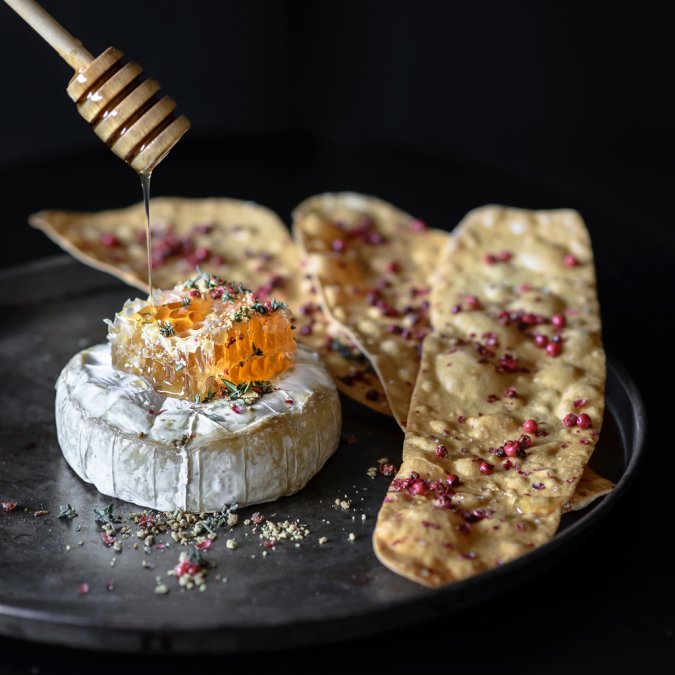
Brie, Camembert and similar soft cheeses are mild and buttery. They need a light touch.
A floral, balanced honey is the right call. Our Wildflower Honey with Hand-cut Honeycomb brings sweetness and a little texture from the comb itself. Spread a small piece of comb on a warm slice of brie and you will understand why this pairing never goes out of fashion.
Hard and Aged Cheeses with Dark, Intense Honey
Aged cheeses are nutty, crystalline and dry. They pair with honey that has depth rather than just sugar.
Our Redgum Honey TA 10+ has a lightly smoked flavour with a spicy, floral aftertaste, which sits well against an aged cheddar or a hard sheep's cheese. For something more unusual, Black Truffle Honey over a mature hard cheese is a pairing that surprises people. It is earthy, almost savoury, and it works.

Benefits of Using Raw Honey in Savoury Recipes
The benefits of using raw honey in savoury recipes come down to two things: flavour depth and texture. Raw honey brings aroma and body that processed syrups simply do not have.
Beyond the board, raw honey earns its place in:
- Salad dressings, whisked with olive oil and lemon
- Roasted root vegetables, drizzled before the oven
- Marinades for pork, lamb or chicken
- Glazes for hard cheese tarts
- A finish for strong, salty dishes that need balancing
Because raw honey is unheated, its aroma survives cooking better than you might expect, particularly when added late. Add it in the last few minutes rather than at the start.
A little goes a long way. Treat it as a seasoning, not a sauce.
Choosing Raw Honey for Cheese Boards: What to Look For
Buy honey the way you would buy cheese: by origin, by process, and by proof. Three checks will separate a genuine raw honey from a supermarket blend.
Look for the word raw. Raw means unheated and minimally filtered. If the label does not say it, assume it is not.
Check the origin. Single-origin honey has a character you can pair with. Blended honey from multiple countries tastes generic because it is designed to.
Look for testing and certification. Our range is chemist certified with a minimum 10+ Total Activity rating, and each jar is laboratory tested. That rating describes the honey's measured activity level, so you know what you are buying rather than guessing from the label design.
Also worth knowing: raw honey crystallises over time. That is a sign of a genuine product, not a fault. Warm the jar gently and it returns to liquid.
Common Mistakes to Avoid When Pairing Honey and Cheese
Most bad cheese boards fail for the same handful of reasons. Fix these and your board improves immediately.
- Using one honey for everything. One honey cannot suit a fresh brie and a strong blue. Bring two.
- Serving cheese straight from the fridge. Cold kills aroma. Wait 30 to 60 minutes.
- Overloading the board. Six cheeses means six half-eaten wedges. Three or four is better.
- Choosing strongly flavoured crackers. Rosemary and chilli crackers fight the honey. Use plain.
- Drizzling everything in advance. Honey spreads and soaks in. Let guests add their own.
- Skipping the acid. Without fruit or pickle, the board turns cloying fast.
- Microwaving crystallised honey. Gentle warmth works. High heat does not.
Pairing honey and cheese well is a skill, not a talent, and the only real barrier is finding honey with enough character to pair with. Mass-market blends are too uniform to work. The Rare Honey Company bottles small batches by hand at source in Western Australia, with every jar chemist certified and cold filtered to keep its natural activity intact. Start with the Redgum Honey TA 10+ for aged cheeses, or the Wildflower Honey with Hand-cut Honeycomb for soft, bloomy rinds. Get started with The Rare Honey Company and build a cheese board people actually remember.
Frequently Asked Questions
Which cheeses pair best with raw honey?
Blue cheese, soft brie, and aged hard cheeses work best. Blue cheese benefits from a high-activity honey like Blackbutt TA30+, which balances the salt and sharpness. Soft cheeses suit floral wildflower honey, while aged hard cheeses match dark, robust honey such as Redgum TA10+. The key is matching intensity and texture rather than following rigid rules.
How do I serve raw honey on a cheeseboard?
Serve honey at room temperature in a small ceramic or glass pot with a wooden dipper. Place it near the cheeses it complements, and let guests drizzle their own portions. For a polished board, warm the honey slightly by standing the jar in warm water for a few minutes, never in a microwave, so it flows easily without losing its raw qualities.
What are the benefits of using raw honey in savoury recipes?
Raw honey adds natural sweetness, depth, and moisture without refined sugar. In savoury dishes it balances salt, acid, and bitterness, and its flavour compounds can complement herbs, spices, and cured meats. Its thicker texture also helps glazes cling to roasted vegetables or meats. Using raw honey means you keep the natural enzymes and antioxidants that heat processing can reduce.
Can I pair high-activity honey with strong blue cheese?
Yes. High-activity honey such as Blackbutt TA30+ has a dark, caramel-like intensity that stands up to pungent blue cheese without being overwhelmed. The honey's sweetness and the cheese's saltiness create a balanced contrast. Serve a small amount, about a teaspoon per portion, so the honey enhances rather than masks the cheese.