

How to Spot Fake Honey in Supermarkets
Table of Contents
- Why Fake Honey Is Sold in Supermarkets
- How to Identify Raw Unheated Honey on the Label
- Common Honey Adulteration Signs to Watch For
- Simple Tests to Spot Fake Honey at Home
- What to Look for on Honey Labels
- How Premium, Authentic Honey Differs
- Frequently Asked Questions
Last Updated: September 28, 2026
Why Fake Honey Is Sold in Supermarkets
Fake honey floods supermarket shelves because it's cheaper to produce and sell than the real thing. Manufacturers blend pure honey with syrups, glucose, and water to cut costs and boost profits. The average consumer can't tell the difference at a glance, so these adulterated products sit right next to authentic honey.
This is where understanding how to spot fake honey becomes essential. Many shoppers assume that if honey is in a supermarket, it must be legitimate. That assumption is costly. The problem isn't limited to budget brands either, some premium-looking jars contain blends that wouldn't qualify as honey under strict food standards.
The incentive is straightforward: pure honey costs more. Corn syrup and glucose cost less. When a manufacturer can sell a jar of blended syrup for nearly the same price as pure honey, the profit margin widens dramatically. This is why learning to spot fake honey matters before you buy.
How to Identify Raw Unheated Honey on the Label
Reading the label is your first line of defence when learning how to spot fake honey. Raw, unheated honey looks different from processed versions, and manufacturers are required to disclose this information.
Look for these key label indicators:
- "Raw" or "Unpasteurised", This tells you the honey hasn't been heated above its natural state
- "Cold-extracted" or "Cold-filtered", These terms mean the honey was processed without high heat, preserving enzymes and nutrients
- "Unfiltered", Indicates pollen and natural particles remain in the honey
- "100% Pure Honey", A legal requirement in many markets, though some products still sneak in additives
- Single-origin or monofloral designation, Examples include Jarrah, Manuka, or clover honey. These are more likely to be authentic than generic "honey blends"
The absence of these terms is a red flag. If a jar simply says "honey" with no further description, it's likely been heated or blended.
Check the ingredient list carefully. Pure honey should have only one ingredient: honey. If you see glucose, corn syrup, sugar, or water listed, you're holding a blend, not authentic honey.
Common Honey Adulteration Signs to Watch For
Sugar syrup and glucose blends
Sugar syrup and glucose are the most common adulterants in fake honey. These cheap sweeteners mimic honey's appearance and texture but offer none of its health benefits.

Redgum Honey TA10+ (Active)
Glucose-blended honey often looks slightly cloudier or has a grainy texture even when it should be smooth. Real honey may crystallise over time, but this is a natural process. Glucose crystallisation looks different, it tends to form larger, more uniform crystals rather than the fine, creamy texture of genuine honey crystallisation.
When you taste glucose-blended honey, it lacks the complex flavour profile of authentic honey. It tastes one-dimensional and overly sweet, like pure sugar rather than the nuanced notes real honey carries.
Corn syrup and high-fructose additives
High-fructose corn syrup is cheaper than honey and nearly invisible to casual inspection. Manufacturers use it because it's liquid at room temperature and visually similar to honey.
Corn syrup blends tend to be thinner and flow more easily than pure honey. Real honey has a thicker, more viscous consistency. When you tilt a jar, authentic honey moves slowly. Fake honey with corn syrup slides quickly.
The taste reveals the problem immediately. Corn syrup tastes artificial and lacks the floral or botanical notes present in real honey. It's aggressively sweet in a way that feels chemical.
Water content and moisture manipulation
Some manufacturers dilute honey with water to increase volume. This lowers the cost per jar and makes the product heavier, which can trick consumers into thinking they're getting more value.
Watered-down honey ferments more easily because water reduces the honey's natural antimicrobial properties. It also crystallises differently, water-added honey often becomes grainy and separated rather than creamy.
The density test (covered below) catches water-added honey instantly. Real honey is denser than water and won't dissolve as readily.
Simple Tests to Spot Fake Honey at Home
The water test
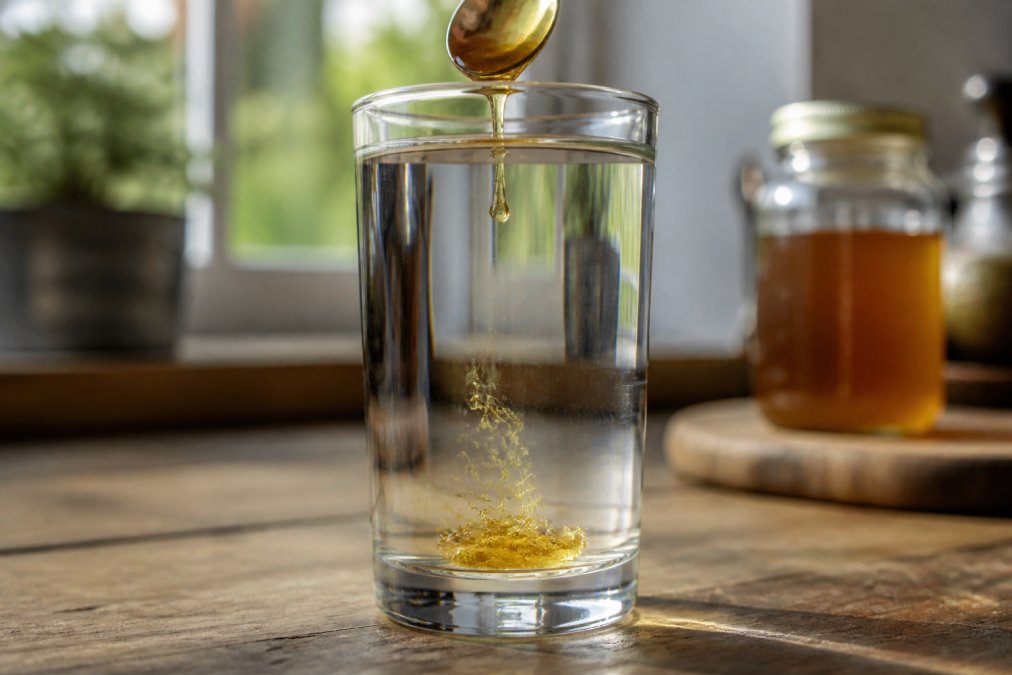
Fill a glass with room-temperature water. Add a tablespoon of honey to the glass.
Real honey sinks to the bottom and dissolves slowly. It may take several minutes to fully disperse through the water. Fake honey or honey blended with water or syrup dissolves quickly and mixes readily with the water.
This test works because pure honey is denser and more viscous than water. The molecular structure of authentic honey resists immediate dissolution. Adulterated honey, being thinner or more water-based, behaves like a standard sweetener.
The crystallisation test
Leave a jar of honey at room temperature for several weeks. Real honey crystallises naturally over time. Fake honey may not crystallise at all, or it crystallises into large, grainy chunks rather than the fine, creamy texture of authentic honey.
Jarrah Honey TA 10+ (Active) →
When authentic honey crystallises, it becomes lighter in colour and develops a smooth, buttery texture. You can re-liquefy it gently by warming the jar in warm (not hot) water. This process is completely normal and doesn't indicate spoilage.
Glucose-blended honey crystallises into hard, separate crystals that don't re-liquefy smoothly. The texture becomes gritty and unpleasant.
The thumb spread test
Place a small amount of honey on your thumb. Real honey stays in place and doesn't spread or drip immediately. It has enough body to hold its shape.
Fake honey or watered-down honey spreads across your skin like syrup. It lacks the thickness and cohesion of authentic honey.
This test is quick and works in the supermarket before you buy. It's not foolproof on its own, but combined with label reading, it gives you confidence in your choice.
What to Look for on Honey Labels
Beyond the raw and unfiltered markers, several other label details indicate authenticity.
Origin and certification matter significantly. Honey from a single, identifiable source is more trustworthy than generic blends. Look for specific regions or botanical sources. The Rare Honey Company's Jarrah and Super Jarrah honeys, for instance, are sourced from Western Australian forests and clearly identified by their origin.

Bioactivity ratings on premium honey indicate genuine quality. Some honeys carry a TA (Total Activity) rating, which measures antimicrobial strength. A TA10+ or TA20+ rating tells you the honey has been tested and verified for its active compounds. This certification doesn't appear on fake honey because blended products won't have measurable bioactivity.
Awards and recognitions provide third-party validation. Great Taste Awards, for example, are judged by independent food critics. If a honey has won such an award, it's been tasted and verified by experts. The Rare Honey Company's Jarrah Honey earned a 3-Star Great Taste Award in 2026, which is a clear signal of authentic quality.
Batch numbers and harvest dates show transparency. Legitimate producers track their honey back to specific harvests. This information helps you understand the honey's age and origin.
Generic supermarket honey often lacks this level of detail. The label might say "Product of Australia" or "Product of Multiple Countries," which signals blending or sourcing from various suppliers with no quality control.
How Premium, Authentic Honey Differs
Authentic premium honey tastes and behaves differently from fake versions. Real honey carries complex flavour notes that reflect its botanical source. Jarrah honey, for example, has a distinctive toffee-like sweetness with treacle notes and a subtle aromatic finish. These flavours come from the specific nectar the bees collected, something impossible to replicate in a blend.
The texture of genuine honey is noticeably thicker and more luxurious. It coats your mouth and throat in a way that syrup-based products simply cannot match. This thickness reflects the honey's natural composition and density.
Real honey also has measurable health properties. Raw, unprocessed honey contains enzymes, antioxidants, and compounds with antimicrobial activity (Checking your browser). When you buy honey with a verified TA rating, you're buying honey that's been tested for these properties. Fake honey has none of this.
The crystallisation process differs too. Authentic honey crystallises into a smooth, creamy spread that you can easily re-liquefy. This is a sign of purity, not spoilage.
Frequently Asked Questions
Does the thumb test for honey actually work?
The thumb spread test has merit but isn't foolproof. Real honey should hold its shape and not spread immediately when placed on your thumb, whilst adulterated honey often runs quickly. However, some genuine honeys crystallise or remain more liquid depending on their type and storage conditions. Use this test alongside label checks and other indicators rather than relying on it alone.
How can I tell if honey has been adulterated with sugar syrup?
Adulterated honey often appears too clear, flows too easily, or crystallises unnaturally fast. Check the ingredient list for anything beyond '100% honey'—any mention of glucose, corn syrup, or fructose indicates adulteration. Authentic raw honey may contain visible pollen particles and should list only honey as the ingredient. Price is also telling: genuine raw honey costs significantly more than supermarket brands.
What does 'raw' honey mean in the context of UK food standards?
Raw honey means it has not been heated above its natural temperature during extraction or processing, preserving naturally occurring enzymes and pollen. In the UK, raw honey is not pasteurised and retains its bioactive properties. Look for labels stating 'raw', 'unpasteurised', or 'cold-extracted'. This distinguishes it from processed supermarket honey, which is typically heated to improve shelf life and appearance, destroying beneficial compounds.
Why is some supermarket honey so cheap?
Cheap supermarket honey is often adulterated with syrups, water, or other sweeteners, or sourced from lower-quality, blended batches. Authentic, raw honey requires careful harvesting from pristine sources and minimal processing, making it more expensive. Premium raw honey from single-origin sources costs more because it delivers genuine bioactive benefits and distinctive flavour. Paying more ensures you're getting actual honey rather than a syrup blend.